
Let me tell you something that I learned the hard way the first week I worked in that busy diner in Portland back in 2012. I saw the line cook cut raw chicken, quickly wash the knife under cold water, and immediately cut up tomatoes from the salad bar. Within hours, three customers reported sick. That shook me up and has forever changed the way I think about raw meat and knife hygiene.
When must a knife be cleaned and sanitized? The answer is simpler than most people think, but getting it wrong can make people seriously sick. According to the CDC’s latest estimates, approximately 48 million Americans get sick from foodborne illness each year, that’s 1 in 6 people, resulting in 128,000 hospitalizations and 3,000 deaths.
Whether you’re cooking dinner at home, running a food truck in Bozeman, Montana, or training kitchen staff at a culinary school-this guide is for you. You’ll learn exactly when and why knife sanitation matters, and how to do it right every single time. No confusing regulations. No scary stories. Just practical food safety that protects everyone who eats your food.
What Does “Cleaned” and “Sanitized” Really Mean?
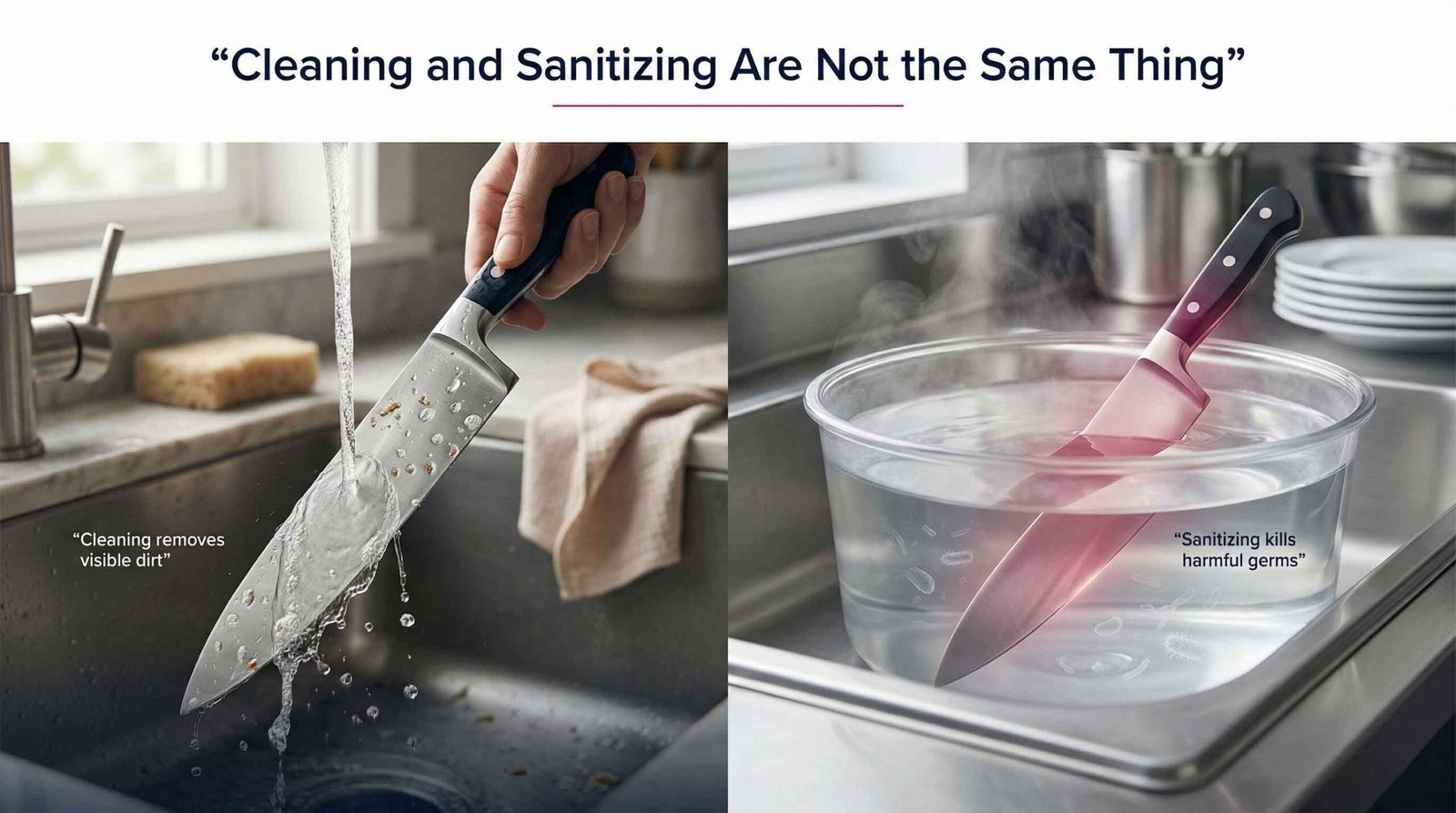
After guiding nearly 200 kitchens over the years, I still see confusion about these two words. People use them like they mean the same thing. They don’t. Understanding the difference between cleaning and sanitizing is fundamental to preventing cross-contamination.
Cleaning Explained (Removing Visible Dirt)
Cleaning is a process of washing away what you see. Food particles. Grease. Sauce. Debris. You use hot water and dishwashing soap to scrub the knife blade to make it clean.
Think of washing as removing the evident dirt from your hands before you eat.
Sanitizing Explained (Killing Harmful Germs)
Sanitizing means killing the germs you cannot see. Bacteria like Salmonella, E. coli, and Listeria hide on surfaces even after cleaning. Sanitizing reduces these harmful microorganisms to safe levels. Research shows that even after wiping, bacteria can remain on knife surfaces and contaminate the next food item you cut.
Water and soap alone won’t kill all bacteria. You need heat or approved sanitizing chemicals.
Why Both Steps Are Necessary
Here’s the error I see every week: A person washes the knife thoroughly and doesn’t sanitize. The knife appears to be sparkling clean, but it has dangerous bacteria on it.
But the other side happens too. A person puts a greasy knife into a disinfectant. It has never been cleaned. This grease keeps the disinfectant away from the bacteria. It fails.
You need both. You need one for the food and grease. You need another for germs. You skip one, and nobody is protected.
When Must a Knife Be Cleaned and Sanitized? (Quick Answer)
Let me give you the straight answer right now. A knife must be cleaned and sanitized:
- After cutting raw meat, poultry, or seafood
- Before switching to ready-to-eat foods
- Between different food types
- After 4 hours of continuous use (in commercial kitchens)
- After touching contaminated surfaces or falling on the floor
- Before and after each shift (in food service settings)
That’s it. Master these six moments and you’ll prevent most cross-contamination in any kitchen.
When Must a Knife Be Cleaned and Sanitized? (Detailed Food Safety Rules)
Let’s break down each scenario so you know exactly what to do.
After Cutting Raw Meat, Poultry, or Seafood
Raw animal products carry the highest bacteria risk in your kitchen. Chicken can have Salmonella. Beef may carry E. coli. Seafood sometimes contains Vibrio. In 2024 alone, two major Salmonella outbreaks—one from cucumbers and another from charcuterie meats—collectively caused 650 confirmed illnesses and about 180 hospitalizations.
The moment you finish cutting raw meat, that knife needs immediate cleaning and sanitizing. No exceptions. No “I’ll just rinse it quick.” No waiting until later.
I once inspected a taco stand in Ellensburg, Washington where the owner Rafiq used the same knife to raw chicken and shredded lettuce without washing in between. He thought rinsing with water was enough. It wasn’t. One health complaint and a two-day closure taught him otherwise.
Before Switching to Ready to Eat Foods
Ready-to-eat foods are anything people eat without cooking. Fresh salads. Sliced fruit. Bread. Cheese. Anything that goes straight from cutting board to plate.
These foods receive no heat treatment to eliminate the bacteria. When your knife transfers germs to these foods, those germs go directly into someone’s body. According to recent outbreak data, 1,392 Americans became ill from contaminated food in 2024, up from 1,118 in 2023—and hospitalizations more than doubled from 230 to 487.
Always clean and sanitize your knife before cutting ready-to-eat items, especially if you’ve been working with raw ingredients.
After Switching Between Different Foods
This rule protects against cross-contamination between different food types:
- Raw meat to vegetables
- Raw foods to cooked foods
- One type of meat to another
- Foods containing allergens to allergen-free foods
Each switch needs to be cleaned and sanitized. Yes, that includes from raw beef to raw pork. The same type of bacteria can make a difference. Research indicates knife-contamination rates related to produce type: 43% for tomatoes, 17% for melons, and 15% for strawberries.
In the commercial kitchen, this can happen dozens of times per shift. Home cooks do this less often but the rule stays the same.
After 4 Hours of Continuous Use (Commercial Kitchens)
Bacteria multiply over time, even on knives that look clean. In restaurants and food service operations, knives must be cleaned and sanitized at least every four hours during continuous use.
This is because bacteria procreate very quickly in room temperatures. Your knife, placed on your work station all afternoon, is going to be a breeding ground for bacteria even if you are only chopping veggies.
Set a timer if you want. After four hours pass, you must stop and clean that blade.
After the Knife Falls or Touches Contaminated Surfaces
The floors are dirty. The trash areas are worse. Bacteria transfer from dirty counters, through used cutting boards, to contaminated hands.
If your knife touches any contaminated surface, it should be cleaned and then sanitised before you use it again. A knife dropped on the floor must be washed and sanitized, not just rinsed and wiped.
I learned this from watching Selo, a prep cook in Kalispell, Montana drop a knife during a rush. He grabbed it, wiped it on his apron and kept chopping. The chef stopped him on the spot. That knife went straight to the dish station.
Before and After Each Shift (Food Service)
Professional kitchens require knife sanitation before starting work and after finishing. This ensures every shift begins with clean equipment and nothing cross-contaminates overnight.
Health inspectors specifically check for this during routine inspections. It’s basic food service hygiene.
Do You Need to Sanitize a Knife Between Foods?
Yes, absolutely.
Anytime you switch between food types, especially from raw to ready-to-eat or between different proteins, you must clean and sanitize your knife.
Here’s a simple example: You’re making dinner. You slice raw chicken breasts, then need to cut tomatoes for a salad. That knife must be washed and sanitized before touching those tomatoes. Skipping this step is how people get food poisoning at home.
The biggest mistake home cooks make is thinking a quick rinse works. Research shows that 66% of consumers don’t wash knives before reuse, and 50% only rinse with water. It doesn’t work. You need full cleaning and proper sanitizing every single time.
Rules for Cleaning Knives, Home vs Restaurant Kitchen
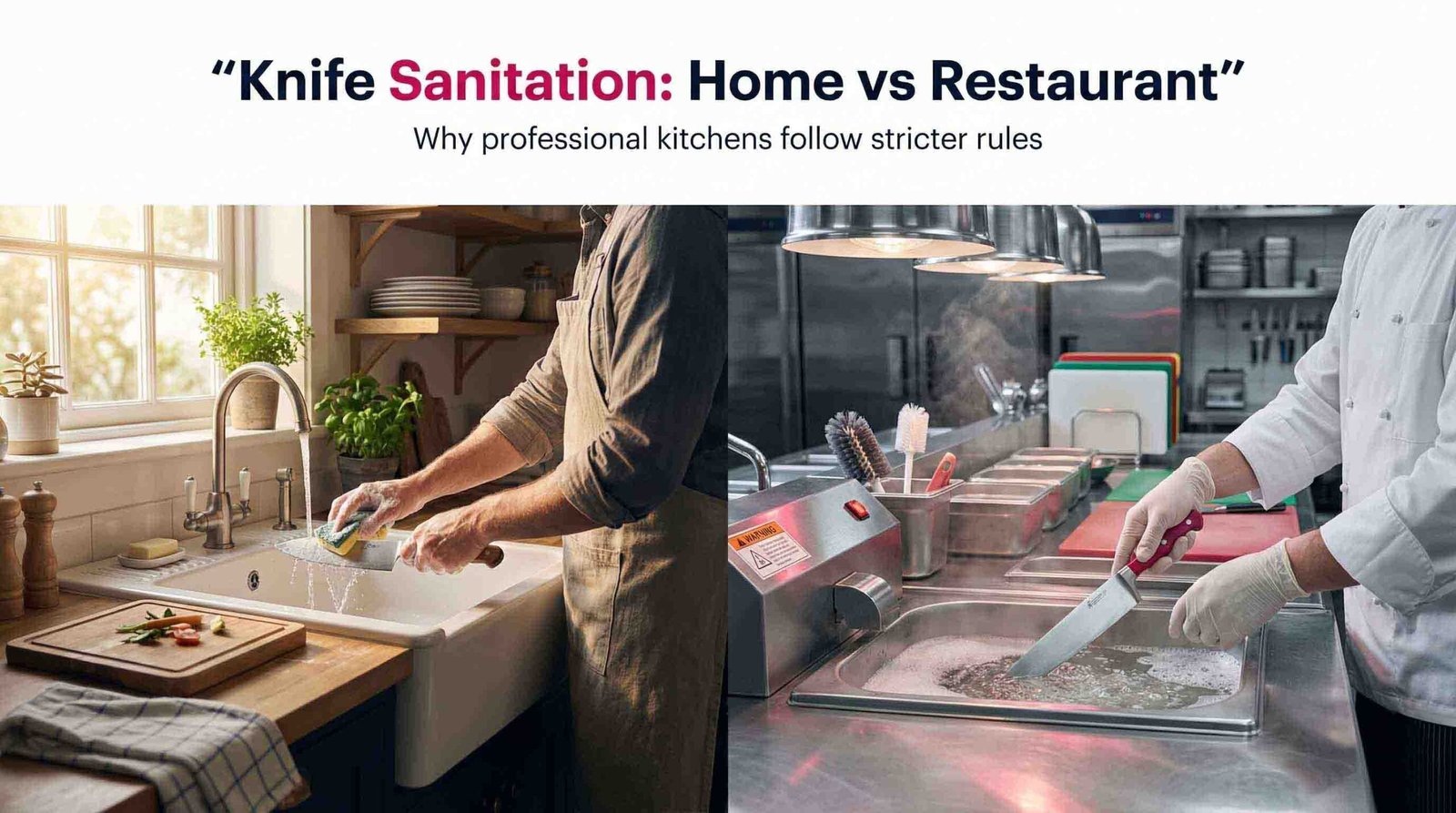
The fundamental principles remain the same, but home and commercial kitchens have different practical requirements.
Home Kitchen Guidelines
Examples include:
In your kitchen, clean the knives:
- Immediately after cutting raw meat, poultry, or seafood
- Before switching between raw and cooked foods
- Between different food types when cross-contamination is a concern
- At the end of your cooking session
You do not need to sanitize at home because you do not work eight-hour days. To eat at the center you must follow the rules of food switching.
Most homemakers have a dishwasher that provides a sanitize option. The hot water method is also a great option that works well.
Restaurant & Commercial Kitchen Rules
Commercial kitchens follow stricter standards:
- Every four hours during continuous use
- Between every task involving different food types
- Before and after each shift
- Immediately after any contamination event
- Whenever required by local health codes
Commercial operations often have three-compartment sinks specifically for washing, rinsing, and sanitizing. Staff must follow these procedures exactly. Health inspections focus heavily on knife sanitation practices.
What Happens If Knives Are Not Properly Sanitized?
I’ve seen the consequences firsthand, and they’re never minor.
Foodborne illness is the biggest risk. When knives transfer bacteria from raw foods to ready-to-eat items, people get sick. The economic burden of foodborne illnesses in the United States reached $74.7 billion in 2023. Symptoms range from stomach cramps to hospitalization, especially for children, elderly people, and those with weak immune systems.
Cross-contamination comes into play when bacteria from the food you are handling spread across your kitchen. With a single contaminated knife, you can contaminate the boards, countertops, other kitchen utensils, as well as a number of dishes. Experiments have shown that the transfer of bacteria by the human hand, the board, or the knife has the same effect.
Health inspection failures shut down restaurants. I’ve watched three establishments close temporarily because inspectors found improper knife sanitation during routine checks. The financial loss and reputation damage took months to repair. The deadliest outbreak in 2024 involved Boar’s Head deli meats, linked to 60 hospitalizations and 10 deaths across 19 states.
For food businesses, the legal and reputation risks are severe. One outbreak traced to your kitchen can end your business permanently.
How to Clean and Sanitize a Knife (Step-by-Step)
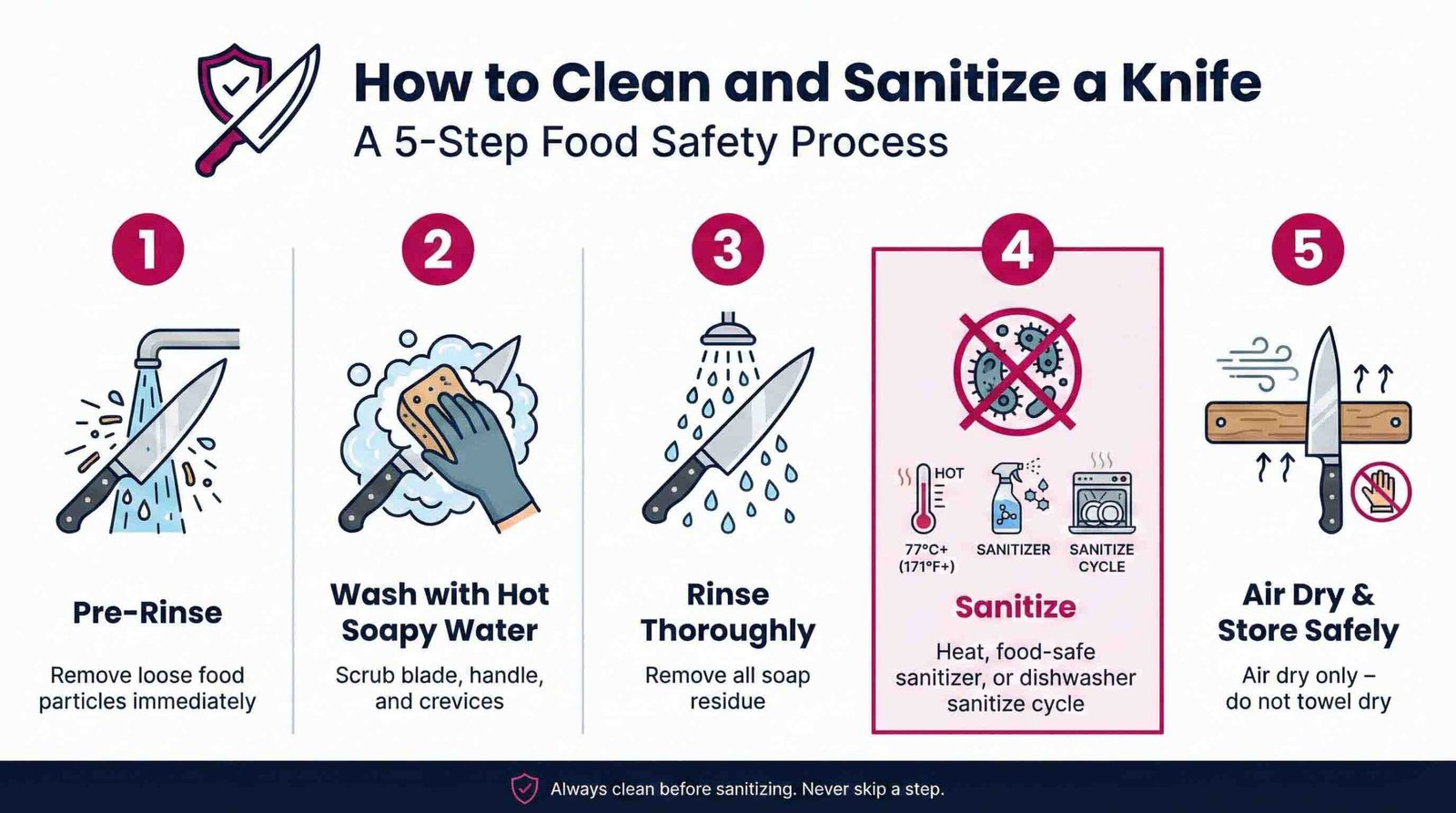
Let me walk you through the correct process I teach every kitchen staff member.
Step 1 – Pre-Rinse
The knife should be rinsed with warm running water immediately after use. This is done to remove loose food particles that could dry up on the knife.
Turn the knife blade away from your body. Wipe in a direction from the back of the knife towards the blade, but never towards your hand.
Step 2 – Wash With Hot Soapy Water
Use hot water (as hot as you are able to stand). Use dishwasher soap. Wash the cutting side of the blade, the handle, and any crevices around the blade where food can settle.
Be sure to pay special attention to the intersection of the blade and the handle. Bacteria thrive in that region.
Rodíate por lo menos 20 segundos. También, deberás lavarte bien si ha sido en contacto con carne cruda.
Step 3 – Rinse Thoroughly
Rinse all soap off the knife under hot running water. Soap residue can affect the next sanitizing step and leave an unpleasant taste on food.
Step 4 – Sanitize (3 Approved Methods)
Hot water method: Submerge the cleaned knife in water heated to at least 171°F (77°C) for 30 seconds. This is the best way to sanitize kitchen knives at home if you don’t have commercial sanitizer.
Food-safe chemical sanitizer: Mix sanitizer according to package directions (usually one tablespoon of unscented chlorine bleach per gallon of water). Submerge the knife for the recommended contact time, usually 30 seconds to a minute. This technique is independent of the temperature of the water.
Dishwasher (if permitted): Some knives can be washed in the dishwasher’s sanitize cycle. However, always check the manufacturer’s recommendations first. Also, high carbon steel and wood should not go in the dishwasher.
Step 5 – Air Dry and Store Safely
Allow the knife to air dry completely. Do not wipe with a towel right after sanitizing, as towels can reintroduce bacteria.
Once clean, knives are to be stored in a dry knife block, magnet strip, or given a protective sheath. Never drop a sanitized knife into a drawer among other utensils.
Common Knife Sanitation Mistakes to Avoid
After years of experiences with hundreds of kitchen employees, these errors are always obvious:
Just water – Just water is not sufficient to kill bacteria. One requires soap water or chemical/cold water.
Cleaning but not sanitizing – The knife appears clean but actually contains unseen bacteria. Remember to always clean and sanitize afterward.
Sanitizing without cleaning – Food residue and grease prevent the sanitizer’s action as it cannot easily reach the bacteria. Clean first, always.
Using towels instead of drying in the air – Even if the towels appear to be clean, they all carry bacteria. Drying in the air is the safest option if the
Letting too long pass between cleanings – The more time the knife has been sitting in the uncleaned state, the more bacteria will grow. Clean the knives immediately after each use.
This mistake has happened to me personally for years before realizing why air drying is so important. Sometimes it’s the simplest thing that makes all the difference.
Knife Sanitation Guidelines You Should Always Follow
These food safety knife sanitation guidelines will keep you safe regardless of where you cook:
Clean as you go – Avoid a buildup of dirty knives. Clean and sanitize knives immediately after use.
Use separate knives whenever possible – Preparing your food with separate knives prevents many of the issues associated with cross-contamination.
Store sanitized knives properly – This is an aspect of preventing re-contamination of the knife once it has been sanitized
Follow established food safety practices – Whether you are considering FDA recommendations, state health department regulations, or USDA guidance, follow established kitchen and sanitation guidelines for knife cleaning.